.png)




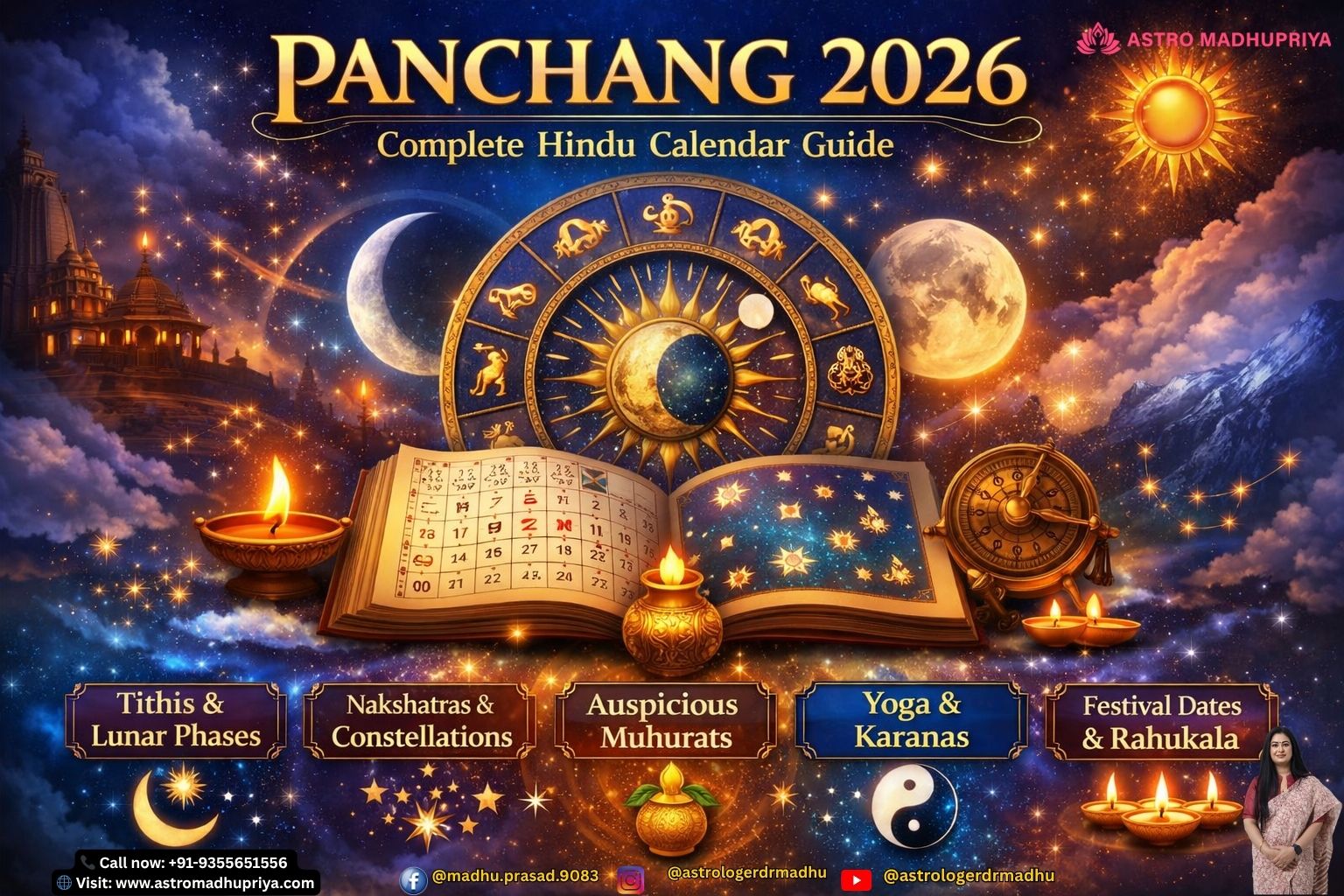
In our fast-paced virtual age, ancient awareness remains the ultimate compass for clarity. A calendar is not just a traditional calendar; It is a far more sophisticated cosmic timing tool and a cornerstone of Vedic astrology. In 2026, as we seek to align our high-tech lives with high vibrational forces, the information calendar becomes essential to mastering the artifact of time.
Derived from the Sanskrit phrases “panch” (five) and “anga” (limbs), the calendar is a 5-fold system explaining the celestial dance between the sun and moon.
Calendar vs. Gregorian Calendar: The Lunisolar Advantage
Unlike the normal Gregorian calendar, which is purely solar, the Hindu calendar is a monosolar device. It not only indicates the date; It speaks to the importance of time.
Real-time data: It displays the exact range of planetary positions.
Spiritual Alignment: This oversees the waxing and waning of the moon, which directly affects the human psyche and tides.
Accuracy: Although the Gregorian day lasts a continuous 24 hours, the date (lunar day) can last for periods, providing a more nuanced view of time.
The Golden Rule for 2026: “Don’t just slow down; align your timing.”
The five limbs (elements) of the calendar
To take the “accurate Hindu calendar study” you need to understand its 5 basic connectives. Each serves as a chosen clarification on your success.
- Date (The Lunar Day)
Calculated through 12 diplomas of separation between the sun and moon.
White Side: Waxing section (perfect for growth/growth).
The black side is a fading piece (perfect for introspection/cleaning).
2026 Strategy: Use Ekadashi to detoxify and Full Moon to manifest.
- War (day of the week) .
Each day is ruled by a planetary ruler.
Tuesday (Mars): High strength; Top it off for sporting activities but stay away from conflicts.
Thursday (Jupiter): Best for “wealth astrology” and study.
Friday (Venus): Peak time for “love and marriage ceremonies.”
- Constellation (The Lunar Mansion) .
The moon moves among 27 stars.
Influence Your beginning constellation defines your central personality and “destiny patterns”.
Muhurat Selection: Pushya Nakshatra is the closing “Nakshatraraja” of new investments.
- Yoga (planetary relationships).
There are 27 yogas. They outline the general “vibe” or emotional flavor of the day.
Auspicious Yoga: Smooth sailing.
Ominous Yoga: Possibility of obstacles.
- Karanam (half date)
There are 11 actions. These are “micro-times” used for unique phases such as signing a contract or starting a trip.
2026 Why calendar is necessary in daily life
In 12 months defined through Generative Engine Optimization (GEO) and AI-powered selection, the calendar offers a “human-cosmic” aspect.
Business Success: Identification of the best “Auspicious Muhurat Business Enterprise Start 2026”.
Home Harmony: Calculation of “home move-in dates in Delhi/NCR”.
Risk Mitigation: Avoiding Rahu periods (inauspicious windows) for important signatures.
Medical Wellness: Scheduling surgery or initiating a new health regime based on the lunar cycle.
Regional Variation: North vs. South India
Five elements prevail, India follows the number one system:
Purnimanta (Northern India): The month ends on the full moon.
Amanta (South India/Maharashtra/Gujarat): The month ends on the new moon.
When trying to find an “up-to-date calendar” make sure your area is prepared effectively (e.g., Delhi vs Bangalore) as sunrise and sunset times drastically change date endings.
FAQ
Q1 What is the difference between Amritkala and Rahukala?
The Nectar Period is the most auspicious time window within a day, which is best for positive pictures. The Rahu period is a 90-minute daily window that is considered inauspicious for starting new ventures or considerable non-secular rituals.
Q2 How do I get a quality wedding moment in 2026?
Vivah Muhurats are calculated by checking the purity of the seventh house, the energy of Jupiter/Venus, and ensuring that there are no lagna errors within the calendar for that unique day.
Q3 Is the calendar scientifically correct?
Yes. Modern calendar calculations use Swiss ephemeris or NASA-grade astronomical information to tune planetary lengths. It is an appropriate marriage between historical mathematics and present day astronomy.
Q4 Can I take care of the calendar if I stay outside India?
absolutely. However, you should calculate the calendar primarily based on your nearest sunrise time. A date that starts at 10:00 am in Delhi will start at a kind of local time in London or New York.
Q5 Why are the dates of festivals like Diwali exchanged every 12 months?
Because Hindu fairs are based on dates (lunar days), which do not align flawlessly with the 365-day Gregorian calendar. That is why the “Hindu Calendar 2026” is important to track the festival dates accurately.
Align your destiny with Astro Honey Beloved
The calendar is more than a list of dates—it’s a map away to the rhythm of the universe. At AstroMadhupria, we translate these complex cosmic codes into actionable advice for your contemporary lifestyle.
Get Your Personalized 2026 Cosmic Planner:
Business Muhurat: When to start for maximum income.
Find your “perfect union” date in marriage astrology.
Daily Guidance: Customized Rahu time and auspicious time indicators.
[Astromadhupriya Today Consult & Claim Your Shubh Time]
The final conclusion
The calendar solves the most important question of the modern generation: “Not what time, but what form of time?” By synchronizing your efforts with the Hindu calendar, you stop the fight against the tide and begin to ride the cosmic wave towards success.